Types of Steel Sheets and Coils: Grades, Uses, and Industrial Applications in India
- November 4, 2026 at 8:48 AM
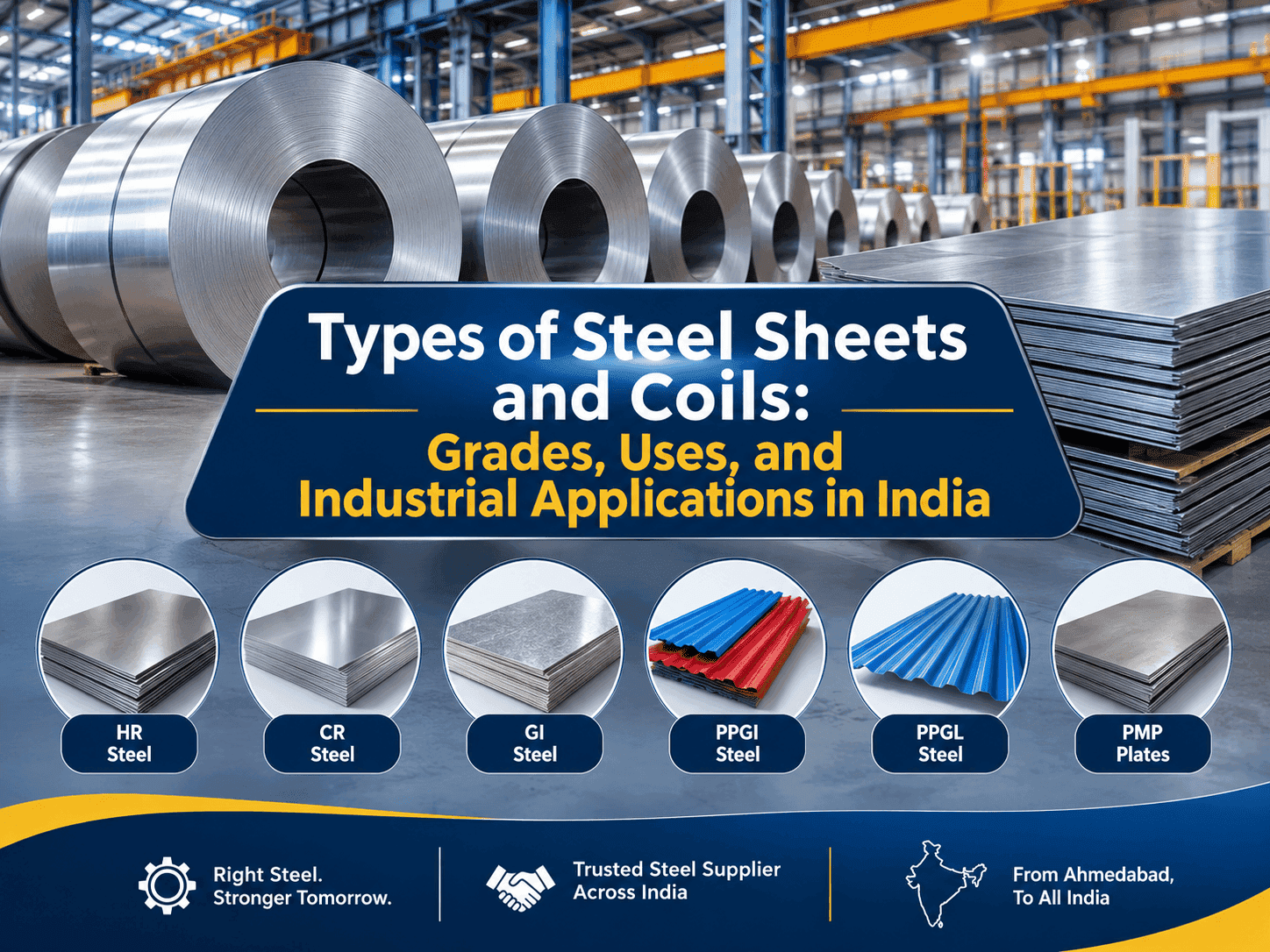
Steel is one of the most widely used materials across construction, infrastructure, automotive manufacturing, engineering, electrical equipment, and industrial fabrication. However, not all steel products are the same. Different manufacturing processes, surface treatments, coating types, and material specifications determine how a steel sheet or coil performs in a particular application.
For manufacturers, fabricators, contractors, and procurement teams, selecting the right steel is important for product quality, fabrication efficiency, durability, and overall project costs. Choosing a reliable Steel Manufacturing Company in Ahmedabad can also help businesses source suitable steel products and meet their specific material requirements.
Some applications require the strength and workability of hot rolled steel, while others need the smooth surface of cold rolled steel or the corrosion protection offered by galvanized and pre-painted steel. Understanding these differences helps businesses choose materials that match their production requirements.
India's steel market offers several options, including HR, HRPO, CR, CRCA, GI, GP, PPGI, PPGL, and PMP steel products. Each serves different industrial and structural requirements.
In this guide, we explain the major types of steel sheets and coils, their characteristics, common applications, and the factors businesses should consider when selecting a dependable steel supplier in Gujarat and across India.
What Are Steel Sheets and Steel Coils?
Steel sheets and coils are flat steel products used as raw materials in manufacturing, fabrication, construction, and various industrial processes.
Steel sheets are flat, rectangular pieces of steel available in different thicknesses, widths, and lengths. They are commonly used in fabrication, machinery manufacturing, automotive components, roofing, and structural applications.
Steel coils are flat steel products wound into large rolls. They are suitable for continuous manufacturing and industrial processing operations such as slitting, cut-to-length processing, profiling, and corrugation.
The choice between sheets and coils generally depends on the production process, required dimensions, material handling facilities, and intended application.
For example, a fabrication unit producing individual components may prefer cut-to-length sheets, while a manufacturer operating continuous processing equipment may require steel coils.
What Are the Different Types of Steel Sheets and Coils?
Steel sheets and coils are classified according to their manufacturing process, surface finish, and protective coating.
Some of the commonly used mild steel products in Indian industries include:
- Hot Rolled (HR) Steel
- Hot Rolled Pickled and Oiled (HRPO) Steel
- Cold Rolled (CR) Steel
- Cold Rolled Close Annealed (CRCA) Steel
- Galvanized Iron (GI) Steel
- Galvanized Plain (GP) Steel
- Pre-Painted Galvanized Iron (PPGI) Steel
- Pre-Painted Galvalume (PPGL) Steel
- PMP Plates
Let's understand how these products differ and where they are commonly used.
1. Hot Rolled (HR) Steel Sheets and Coils
Hot rolled steel is produced by passing steel through rollers at high temperatures. This process makes the material easier to shape and form into different thicknesses and dimensions.
HR steel generally has a characteristic mill-scale surface and is widely used in applications where structural strength, workability, and cost efficiency are important.
Key Characteristics of HR Steel
- Good malleability and formability.
- Suitable for cutting, welding, and fabrication.
- Available in different thicknesses and dimensions.
- Suitable for structural and heavy-duty applications.
- Generally more economical for applications where a smooth surface finish is not essential.
Common Applications of HR Steel
Hot rolled steel is used in several industries, including:
- Construction and infrastructure.
- Heavy machinery manufacturing.
- Structural fabrication.
- Shipbuilding.
- Railway components.
- Industrial equipment manufacturing.
- Agricultural machinery.
HR steel is generally preferred when the application prioritises structural performance and fabrication flexibility over a refined surface finish.
2. Hot Rolled Pickled and Oiled (HRPO) Steel
HRPO steel is a processed form of hot rolled steel. It undergoes an additional pickling process to remove surface scale formed during hot rolling, followed by oiling to provide temporary protection during storage and handling.
The additional processing gives HRPO steel a cleaner surface compared with conventional hot rolled steel.
Key Characteristics of HRPO Steel
- Cleaner surface finish than standard HR steel.
- Reduced mill scale.
- Suitable for further fabrication and processing.
- Good workability and weldability.
- Oiling provides temporary protection against surface corrosion.
Common Applications of HRPO Steel
HRPO steel is commonly used in:
- Automotive components.
- Industrial machinery.
- Metal furniture.
- Fabricated components.
- Steel pipes and tubing.
- Engineering applications.
- Manufacturing components requiring a cleaner surface.
Businesses often consider HRPO when they need the workability of hot rolled steel with improved surface cleanliness for subsequent manufacturing processes.
3. Cold Rolled (CR) Steel Sheets and Coils
Cold rolled steel is produced by further processing hot rolled steel at or near room temperature. This process reduces the material thickness and improves dimensional accuracy and surface finish.
Compared with conventional hot rolled steel, CR steel generally offers a smoother surface and closer thickness tolerances.
Key Characteristics of CR Steel
- Smooth and uniform surface finish.
- Better dimensional accuracy.
- Consistent thickness.
- Suitable for bending and forming operations.
- Good suitability for painting and finishing processes.
Common Applications of CR Steel
CR steel is widely used in:
- Automotive components.
- Home appliances.
- Metal furniture.
- Electrical equipment.
- Storage cabinets and lockers.
- Precision engineering.
- Industrial enclosures.
Cold rolled steel is a suitable choice for manufacturers who require a refined surface finish and consistent dimensions for their products.
4. Cold Rolled Close Annealed (CRCA) Steel
CRCA steel is cold rolled steel that undergoes an additional annealing process. Annealing involves controlled heating and cooling to improve the material's workability and formability.
This makes CRCA steel suitable for applications that require bending, pressing, drawing, and other forming operations.
Key Characteristics of CRCA Steel
- Smooth and uniform surface.
- Improved formability.
- Suitable for bending and pressing.
- Consistent material properties.
- Useful for components requiring complex shapes.
Common Applications of CRCA Steel
CRCA steel is frequently used in:
- Automotive body components.
- Electrical panels.
- Home appliance manufacturing.
- Office furniture.
- Cabinets and enclosures.
- Metal storage systems.
- Precision fabrication.
For manufacturers producing components with specific shapes and surface requirements, CRCA steel can offer advantages over conventional hot rolled materials.
5. Galvanized Iron (GI) Steel Sheets and Coils
Galvanized steel is produced by applying a protective zinc coating to steel. The zinc layer helps protect the underlying steel from corrosion by acting as a barrier and providing sacrificial protection.
GI steel is widely used in applications where exposure to moisture and environmental conditions makes corrosion resistance important.
Key Characteristics of GI Steel
- Zinc coating provides corrosion protection.
- Suitable for various fabrication processes.
- Available in different coating specifications.
- Can be used for roofing and cladding.
- Suitable for indoor and outdoor applications depending on coating and environmental conditions.
Common Applications of GI Steel
GI steel is commonly used in:
- Roofing and cladding.
- HVAC ductwork.
- Electrical equipment.
- Automotive components.
- Fencing and enclosures.
- Industrial sheds.
- Utility poles.
- Metal fabrication.
The appropriate GI product should be selected based on coating requirements, thickness, intended exposure conditions, and fabrication needs.
6. Galvanized Plain (GP) Steel Sheets
GP steel refers to galvanized plain steel sheets with a flat, unprofiled surface. These products are used in applications where a galvanized protective coating and a plain sheet format are required.
The term GP is commonly used in the Indian steel trade. Buyers should confirm the actual coating type and product specifications rather than relying on the product abbreviation alone.
Key Characteristics of GP Steel
- Plain sheet surface.
- Protective galvanized coating.
- Suitable for fabrication and forming.
- Available in different thicknesses and dimensions.
- Useful for applications requiring corrosion protection.
Common Applications of GP Steel
GP steel sheets are used in:
- Electrical panels.
- Industrial enclosures.
- Metal cabinets.
- HVAC applications.
- Roofing and fabrication.
- Electrical equipment manufacturing.
The selection of GP sheets should consider coating specifications, thickness, and the final application.
7. Pre-Painted Galvanized Iron (PPGI) Steel
PPGI steel is manufactured using galvanized steel as its base material, with additional surface treatment, primer, and paint coating.
The pre-painted finish provides both a decorative appearance and additional surface protection. It also reduces the need for painting after fabrication in many applications.
Key Characteristics of PPGI Steel
- Pre-painted surface finish.
- Available in different colours and coating specifications.
- Suitable for roofing and cladding.
- Good formability depending on the base material.
- Additional surface protection through the coating system.
- Available for different architectural and industrial applications.
Common Applications of PPGI Steel
PPGI steel is widely used in:
- Residential and industrial roofing.
- Commercial building cladding.
- Architectural panels.
- Agricultural sheds.
- Appliance enclosures.
- Signage and display structures.
- Industrial building components.
PPGI is a practical choice for projects where appearance, surface protection, and fabrication requirements need to be considered together.
8. Pre-Painted Galvalume (PPGL) Steel
PPGL steel is a pre-painted steel product that uses a Galvalume-coated base material. Galvalume coatings generally contain aluminium and zinc, with a small amount of silicon.
The combination of a metallic coating and a pre-painted finish makes PPGL suitable for several architectural and industrial applications.
Key Characteristics of PPGL Steel
- Pre-painted surface.
- Aluminium-zinc-based metallic coating.
- Suitable for roofing and cladding.
- Available in different colours and specifications.
- Good suitability for applications exposed to outdoor conditions.
- Offers a combination of appearance and corrosion protection.
Common Applications of PPGL Steel
PPGL steel is commonly used in:
- Industrial roofing.
- Commercial building cladding.
- Agricultural structures.
- Architectural panels.
- Industrial sheds.
- Building envelopes.
- Exterior building applications.
PPGL is often considered for applications where coating performance, appearance, and environmental exposure are important selection factors.
9. PMP Steel Plates
PMP plates are another category of steel products used in industrial and fabrication applications. Their suitability depends on the supplied material grade, dimensions, surface finish, and specified requirements.
At V Metal Solutions INC, PMP plates form part of the company's mild steel product range.
Key Characteristics and Considerations
When selecting PMP plates, buyers should evaluate:

- Material grade.
- Plate thickness.
- Dimensional requirements.
- Surface finish.
- Flatness requirements.
- Fabrication and application requirements.
Common Applications of PMP Plates
PMP plates can be used in applications such as:
- Industrial fabrication.
- Heavy-duty flooring.
- Structural components.
- Machinery manufacturing.
- Bridge and infrastructure components.
- Equipment manufacturing.
- General engineering applications.
The final material selection should be based on the technical specifications and intended use of the plate.
Difference Between HR, CR, GI, PPGI and PPGL Steel
Understanding the differences between steel products helps businesses avoid material mismatches and unnecessary processing costs.
The following table provides a general comparison.
| Steel Type | Main Processing | Surface Characteristics | Common Applications |
|---|---|---|---|
| HR Steel | Hot rolling | Mill-scale finish | Construction, machinery, structural fabrication |
| HRPO Steel | Hot rolling, pickling and oiling | Cleaner, oiled surface | Automotive and industrial components |
| CR Steel | Cold rolling | Smooth and uniform | Appliances, furniture, automotive |
| CRCA Steel | Cold rolling and annealing | Smooth, suitable for forming | Electrical panels, cabinets, automotive parts |
| GI Steel | Zinc coating | Galvanized surface | Roofing, ductwork, enclosures |
| GP Steel | Galvanized plain sheet | Flat galvanized surface | Electrical and industrial fabrication |
| PPGI Steel | Galvanized base with paint coating | Pre-painted surface | Roofing, cladding, architectural panels |
| PPGL Steel | Galvalume base with paint coating | Pre-painted surface | Industrial roofing and building applications |
| PMP Plates | Product-specific processing | Depends on supplied specification | Industrial and structural fabrication |
The right product depends on the required surface finish, corrosion protection, forming requirements, material grade, and operating environment.
How to Choose the Right Steel Sheet or Coil for Your Business
Selecting steel is not just about comparing prices. The material must meet the functional and technical requirements of the final product.
Here are some important factors businesses should evaluate before purchasing steel sheets or coils.
1. Identify the Application
Start by understanding where and how the steel will be used.
For example, structural fabrication may require HR steel, while electrical panels and appliance enclosures may benefit from CR or CRCA steel.
Similarly, roofing and cladding projects may require GI, PPGI, or PPGL depending on the design and exposure conditions.
2. Check the Material Grade
Steel grades define important mechanical and chemical properties of the material.
Before placing an order, confirm the required grade according to the applicable product standard and project specifications.
Choosing an unsuitable grade can affect forming, welding, strength, and final product performance.
3. Consider Thickness and Dimensions
Steel sheets and coils are available in different thicknesses and widths.
The required dimensions depend on the manufacturing process and final application. Buyers should confirm thickness, width, length, tolerances, and any processing requirements before ordering.
4. Evaluate Surface Finish and Coating
Surface finish becomes particularly important when steel is used for visible components, painting, or outdoor applications.
For example:
- HR steel is suitable where a conventional mill-scale surface is acceptable.
- CR steel offers a smoother surface.
- GI steel provides zinc-based corrosion protection.
- PPGI and PPGL provide pre-painted finishes.
The coating specification should match the environmental and performance requirements of the project.
5. Check Processing Requirements
Some businesses require steel in specific formats rather than standard coils or sheets.
Depending on the production process, requirements may include:
- Coil slitting.
- Cut-to-length processing.
- Corrugation.
- Profiling.
- Bending.
- Custom dimensions.
Choosing a supplier with suitable processing capabilities can simplify procurement and reduce additional handling.
6. Compare Quality, Availability and Delivery
Consistent material quality and dependable supply are important for maintaining production schedules.
Before finalising a supplier, check product availability, material specifications, documentation, processing capabilities, delivery commitments, and pricing terms.
A reliable supplier should be able to understand your requirements and help identify a suitable product.
Why Choosing the Right Steel Supplier Matters
Steel procurement involves more than finding a supplier offering a competitive price. Businesses need materials that match their specifications and can be supplied within the required timelines.
An experienced steel supplier can help simplify the process by offering different steel categories, product formats, and processing services under one procurement relationship.
For manufacturers and fabricators, this can help with:
- Access to multiple steel product categories.
- Material selection based on application requirements.
- Availability of sheets, coils, and slitted coils.
- Processing support for different production requirements.
- Better coordination of procurement and delivery.
- Consistency in material specifications.
Businesses searching for a Steel Manufacturing Company in Ahmedabad or a dependable steel supplier in Gujarat should evaluate the complete supply capability rather than making a decision based on price alone.
Steel Sheets and Coils Supply by V Metal Solutions INC
V Metal Solutions INC is an Ahmedabad-based steel supplying company serving industrial and manufacturing requirements. Established in 2020, the company deals in mild steel sheets, coils, slitted coils, and corrugated sheets based on customer requirements and specifications.
Its product portfolio includes HR/HRPO, CR/CRCA, GI/GP, PPGI/PPGL, PMP plates, and other steel products.
The company also offers value-added processing services, including coil-to-coil processing, cut-to-length, slitting, corrugation, profiling, and bending.
These capabilities help businesses source different steel products and processing requirements through a single supplier.
For companies looking for a Steel Supplier in Gujarat, V Metal Solutions INC provides steel products and processing support from its coil processing service centre in Ahmedabad.
Whether your requirement involves industrial fabrication, roofing, electrical equipment, automotive components, or structural applications, selecting the right material and specifications is an important part of the procurement process.
Contact V Metal Solutions INC to discuss your steel requirements and find suitable products for your application.
Frequently Asked Questions
Related Blogs

How to Choose the Right Mild Steel Structure for Your Project
The ideal selection of mild steel construction for a project has an excellent correlation to the success of that project, its life...

Mild Steel – All You Need to Know
Mild steel has become a prominent material in modern-day industries creating...

Top Trends in Metal Processing Technologies for 2025
The metal processing industry constantly evolves, aided by technology, sustainability targets, and unceasing calls for efficiency ...

The Role of Customized Mild Steel Products in Modern Construction
There are high demands for versatile, durable, and sustainable construction materials at a rapid pace of urbanization and arch...

Budget 2025-26 and Its Impact on the Steel Industry: A Strategic Outlook
The multifaceted steel industry has evolved into an indispensable spine to development in almost all sectors, ranging from tall bu...

Why are MS Pipes the preferred choice for high-rise buildings?
In the contemporary era of architecture/construction, high-rise buildings have been viewed as a symbol of progress, advancement, a...

The Importance of High-Quality Structural Components in Bridge Construction
Bridges demonstrate the incredible combination of engineering science and architectural vision through their construction, connect...

A Huge Step to Converse India Imposes 12% Safeguard Duty on Steel Imports: ...
On April 21,2025, the Indian government introduced a 12% provisional safeguard duty on flat steel imports for 200 days. This is a ...
How Global Conflicts Are Impacting the Steel Industry in 2026
In 2026, global tensions are reshaping industrial ecosystems, which are experiencing ripple effects across supply chains and pric...
How to Choose a Reliable Steel Manufacturer in Ahmedabad, Gujarat and India
Steel plays an important role in construction, infrastructure, manufacturing, automotive, engineering, and several other industrie...